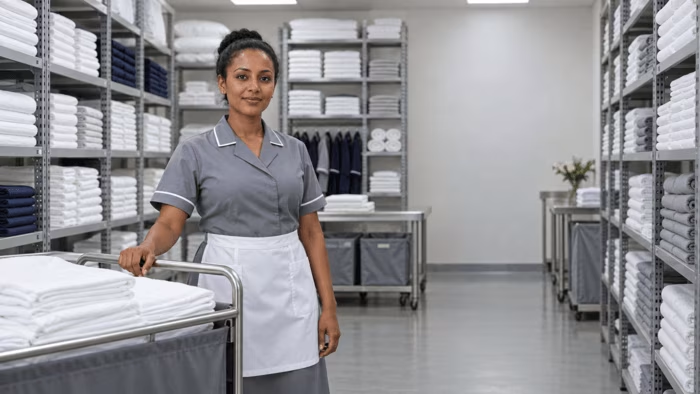
Laundry work can look simple from the outside, but the role changes significantly with the workplace.
A household may need careful garment sorting, ironing, folding, and attention to delicate fabrics. A hotel laundry room deals with repeated linen cycles, larger volumes, commercial equipment, and faster turnaround. Larger facilities may also require workers who can operate consistently as part of a structured team.
For recruitment partners, this means the right candidate should be selected around the actual laundry environment, not the job title alone.
My Agency therefore considers workload, fabric range, equipment, operating pace, and staffing model before building the candidate route.
🧺 Household Laundry — Detail Comes First
Household laundry usually involves a wide variety of personal clothing and fabrics.
The worker may be expected to handle:
-
Everyday clothing
-
Delicate garments
-
Whites and colored items
-
Hand-wash items
-
Ironing and steaming
-
Folding and organization
-
Care-label instructions
-
Household washing equipment
Attention to detail matters because garments may require different temperatures, washing methods, or finishing techniques.
A worker who performs well in this setting should be able to separate items correctly, maintain an orderly routine, and avoid treating every fabric in the same way.
Laundry workers form one part of My Agency's wider domestic recruitment options in Ethiopia, but their suitability should still be considered according to the actual environment where they will work.
🏨 Hospitality Laundry — Consistency Meets Volume
Hotel and hospitality laundry has a different rhythm.
Instead of handling mainly individual garments, the worker may deal repeatedly with:
-
Bed linen
-
Towels
-
Uniforms
-
Restaurant textiles
-
Guest laundry
-
Larger washing loads
-
Commercial pressing
-
Repeated sorting cycles
The work often requires greater consistency across larger quantities.
Speed also matters, but it should not come at the expense of correct sorting, cleanliness, or finishing quality.
A worker with only household experience may therefore need additional preparation before entering a busy hospitality laundry operation.
🏭 Facility Laundry — Workflow Matters as Much as Technique
Larger facilities introduce another layer: the worker becomes part of a process.
The role may involve:
-
Working at a defined station
-
Handling batches of laundry
-
Coordinating with other workers
-
Moving linen between stages
-
Following a shift-based routine
-
Using commercial equipment
-
Maintaining consistent output
-
Completing handovers between work areas
For this type of requirement, individual laundry skill is only part of the profile.
The candidate should also be comfortable with a more structured environment where work moves continuously between sorting, washing, drying, pressing, folding, and distribution.
Through Corporate & Facility Staffing, the candidate route can reflect these larger operational requirements rather than relying only on household laundry experience.
📌 Key Point: Facility readiness should be assessed separately instead of being assumed from general laundry experience.
👕 Fabric Handling Still Matters at Every Scale
Higher volume does not remove the need for correct fabric care.
Workers may still need to distinguish between:
-
Delicate materials
-
Cotton
-
Synthetic fabrics
-
Whites
-
Colored items
-
Uniforms
-
Linen
-
Heat-sensitive garments
-
Special-care items
What changes is the pattern of work.
A household may contain many different personal garments in small quantities.
A hotel may process hundreds of similar towels, sheets, or uniforms.
A facility contract may combine large volume with several textile categories.
The fabric range and the volume should both be understood before candidate selection.
⚙️ Equipment Familiarity Should Match the Workplace
Laundry equipment also changes from one setting to another.
A household worker may mainly use:
-
Standard washing machines
-
Household dryers
-
Steam irons
-
Ironing boards
A commercial laundry environment may involve:
-
Larger-capacity machines
-
Commercial steam equipment
-
Pressing stations
-
Laundry trolleys
-
Sorting tables
-
Structured linen-flow systems
Previous experience with specific equipment can be useful, especially for partners operating larger laundry rooms.
However, equipment familiarity should be recorded accurately rather than assumed.
If a candidate has experience with a particular commercial system, that information can be added to the file when relevant.
⚠️ Important: Familiarity with commercial equipment should be verified when it is important to the receiving operation.
📊 How the Work Setting Changes the Staffing Route
| Work Setting | Main Candidate Priority | Equipment Focus | Typical Volume | Staffing Approach |
|---|---|---|---|---|
| Household | Fabric care and finishing | Household equipment | Low to moderate | Individual worker |
| Hotel / Hospitality | Linen flow and consistency | Commercial pressing | Moderate to high | Individual or multiple workers |
| Facility Operation | Workflow and volume handling | Commercial systems | High | Team or recurring supply |
| Partner-Specific Contract | Requirement-led profile | Site-defined equipment | Contract-based | Customized route |
The purpose is not to rank one worker type above another.
It is to identify which kind of laundry experience fits the receiving environment.
🌍 Regional Orders Can Cover Very Different Laundry Needs
Recruitment partners serving GCC and wider regional markets may handle several types of laundry demand.
For example, partners working with Saudi Arabia may receive household, hospitality, or facility requests, while agencies serving Lebanon may also need workers for different operating environments.
The destination gives useful context, but it does not define the whole role.
The actual workplace remains more important:
-
Private household
-
Hotel
-
Staff accommodation
-
Commercial facility
-
Institutional laundry room
-
Multi-site contract
My Agency uses the market as one part of the requirement rather than assuming that every order from the same country needs the same worker profile.
👥 One Worker, Several Workers, or a Recurring Pipeline?
Laundry staffing requirements can differ significantly in scale.
A partner may need:
-
One household laundry worker
-
One worker for a hotel laundry room
-
Several workers for the same facility
-
Similar workers across multiple sites
-
A recurring candidate pipeline
-
Separate groups for household and facility clients
Through O2O Wholesale Supply, the supply route can be adjusted to the required volume.
A larger order may require more attention to:
-
Candidate consistency
-
Similar skill levels
-
Group preparation
-
File organization
-
Availability
-
Supply timing
The goal is not simply to increase candidate numbers.
It is to make sure the group fits the same operating requirement.
🔄 A Change in Environment Can Change Candidate Suitability
A shortlisted worker may no longer be the best fit if the job changes materially.
Examples include:
-
Household work changes to hotel laundry
-
Low volume becomes high volume
-
Household ironing changes to commercial pressing
-
An individual role becomes part of a larger team
-
Basic clothing care expands into hotel linen operations
When this happens, the candidate should be reviewed again.
A worker may still be suitable, but suitability should not be assumed simply because the job title remains “laundry worker.”
The workplace, equipment, and workload define the practical demands of the role.
🏢 Adapt the Supply Route Around the Partner
A partner working with a manpower employment agency in Ethiopia may have very different laundry requirements from one order to the next.
The first request may involve household workers.
The next may require a team for a hospitality property.
Another may involve a facility with commercial pressing equipment and higher daily volume.
Using the same candidate profile for every request would reduce matching accuracy.
My Agency adjusts sourcing and candidate presentation around the receiving environment, staffing model, and operating scale.
📝 Keep the Important Laundry Details on the File
A clear candidate file should preserve the information that affects suitability.
Useful details may include:
-
Previous work setting
-
Typical laundry volume
-
Fabric types handled
-
Equipment experience
-
Commercial pressing familiarity
-
Household or facility background
-
Team experience
-
Shift-based work exposure
-
Partner-specific requirements
These details help the receiving partner understand what the worker has actually done before.
They also reduce the chance of important information being lost between candidate selection and arrival.
❓ Frequently Asked Questions
-
What information helps define the right laundry worker profile?
The work setting, expected daily volume, main fabric types, equipment used, staffing model, and previous relevant experience are the most useful details.
-
Can a household laundry worker move directly into hotel laundry work?
Not always. Hotel laundry can involve higher volume, commercial equipment, repeated linen cycles, and more structured workflows.
-
Why does equipment experience matter?
Commercial laundry rooms may use pressing and handling systems that differ considerably from household equipment. Relevant familiarity can reduce the adjustment needed after arrival.
-
Can one order include household and facility laundry workers?
Yes. Separate candidate groups can be prepared when a partner serves different types of clients or work environments.
-
Does fabric-care experience still matter in large facilities?
Yes. Higher volume does not remove the need for correct sorting, heat awareness, and appropriate handling of different textile types.
-
What happens if the work setting changes after shortlisting?
The candidate should be reviewed again when the change materially affects equipment, workload, volume, or workflow expectations.
📩 Match the Worker to the Laundry Operation
Send My Agency the work setting, expected volume, main fabric types, equipment, staffing model, and required headcount.
We will adapt candidate sourcing and staffing around the actual laundry environment.
Contact My Agency to send your laundry workforce requirement.