
A supplier says its candidates are trained. Its licence is valid. Its process is fast. Its replacement support is reliable. These claims sound reassuring, but what do they prove?
Not enough to make a sourcing decision.
In office-to-office (O2O) recruitment, a credible supplier explains each claim, supports it with evidence, and identifies the responsible party. This matters whether you are reviewing an established partner or assessing a new provider of office-to-office workforce supply.
The six questions below are designed for GCC recruitment agencies and other authorised receiving partners. They are not a substitute for legal due diligence. Use them before sending a demand letter or promising an outcome.
💡 A useful test: For each question, listen for a specific answer, ask what supports it, and agree on the next follow-up if anything is unclear.
🛡️ 1. Who Holds the Government License, and Can I See It?
A wholesale supplier should identify the legal entity providing the service, the authority that licenses it, and the activities the licence covers. “We are government approved” is a claim, not the supporting detail your agency needs.
What a Credible Answer Includes
Ask for the entity's registered name, licence details, issuing authority, and a copy or verifiable reference where disclosure is permitted. Check whether the name matches the party named in your proposed agreement. If another company is involved in sourcing or documentation, clarify its role as well.
When comparing recruitment agencies in Ethiopia, assess the specific legal entity, not just a familiar agency name.
The Follow-Up That Tests the Claim
“Can we verify that this licence covers the activities you will perform for our agency?”
✅ Strong answer: The supplier names the entity and authority, identifies the relevant scope, and offers a practical way to verify the details.
⚠️ Warning sign: The supplier provides only a logo, an undated image, or an assurance that “everyone knows us.”
Verify supporting documents through appropriate official channels.
🎓 2. What Does Your Training Curriculum Actually Cover, by Category?
“Fully trained candidates” is too broad. Training should match each role’s tasks and limits. A housekeeping candidate and an elderly-care support candidate should not be assessed through an identical set of practical exercises.
Ask for the Curriculum, Not the Slogan
A useful response explains the subjects taught, how skills are demonstrated, and how performance is evaluated. It should distinguish orientation from hands-on practice. Ask what happens if further preparation is needed.
Consider an agency evaluating elderly caregiver suppliers in Ethiopia. It may need evidence of safe assistance practices, communication skills, and awareness of role boundaries. A list of topics does not prove practical competence.
What Evidence Should You Request?
-
✅ A role-specific module outline and the practical skills it covers.
-
✅ The method used to observe or assess each relevant skill.
-
✅ A clear explanation of what “passed training” means.
-
✅ Any preparation limits that the receiving agency must address after arrival.
Illustrative supplier reply: “Candidates practise the required tasks under supervision. We record whether they meet the agreed standard and identify any gaps before shortlisting.”
Follow-up: “Can you show us the assessment criteria for the role in our demand letter?”
💡 Remember: Pre-departure training supports readiness. It does not replace workplace orientation, clear job instructions, or safe supervision after arrival.
📝 3. What Is Your Replacement Policy in Writing?
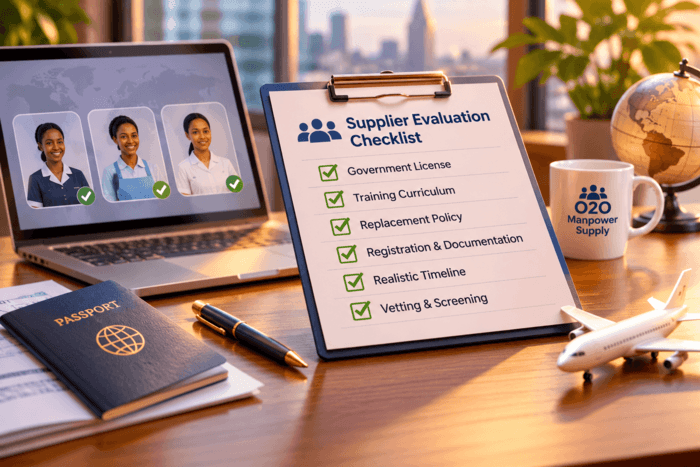
A promise to “replace anyone” invites questions. What qualifies? Who reports it? When? Who pays?
Your agency needs written answers before a placement difficulty arises.
Read the Conditions, Not Only the Headline
Review the proposed agreement with attention to:
-
🔹 Triggers: Which situations may qualify for a replacement review?
-
🔹 Notice: How and when must the receiving agency report a concern?
-
🔹 Evidence: What information is needed, without exposing unnecessary private details?
-
🔹 Responsibilities: What must each party do while the issue is assessed?
-
🔹 Costs and exclusions: Which expenses or circumstances are outside the policy?
Replacement is not necessarily automatic. Outcomes depend on written terms, applicable rules, and worker rights.
Test the Policy With One Scenario
Ask: “If the role described in our demand letter differs from the work expected after arrival, how would you review the case?”
A credible supplier explains the reporting route, the facts it would examine, and the options available under the agreement. An evasive one repeats, “Don't worry; we will solve it.”
⚠️ Warning sign: The written agreement does not reflect the replacement assurance made during sales discussions.
🌐 4. How Do You Handle Musaned, Tadbeer, or Sanad Registration?
This question tests whether a supplier understands the receiving agency's processing route. It does not mean the named systems are interchangeable or that every supplier has direct access to each one.
Musaned serves Saudi Arabia’s domestic-worker recruitment framework. In the UAE, processing can involve MOHRE-approved domestic-worker service centres, including Tadbeer centres. If a partner mentions Sanad or another channel, confirm the exact service and authority instead of assuming a universal process.
Start With the Receiving Agency's Requirements
Your supplier should ask which country and route apply, what candidate information is required, and which party submits or verifies each item. It should also explain how missing or inconsistent details are handled before they delay the application.
For example, a partner discussing Bahrain recruitment requirements should expect the supplier to request the relevant current receiving-side instructions, not simply reuse a document list prepared for a different market.
Ask Who Owns Each Handoff
A meaningful answer might distinguish between collecting candidate details, checking consistency, preparing agreed documents, and submitting information through a channel controlled by the authorised receiving party.
Follow-up: “Which records do you prepare, which steps belong to our agency, and what do you need from us first?”
For a closer look at this distinction, see our guide to registration-route questions.
📌 Practical note: Confirm the current requirements through the relevant official authority or authorised receiving partner. Platform names alone do not establish compliance.
⏳ 5. Can You Show Me a Realistic Timeline, With Reasons?
A useful timeline is not a single confident date. It is an estimate built on stated assumptions. Candidate availability, role requirements, assessment outcomes, documentation, destination procedures, and travel arrangements may each affect progress.
Ask which steps can overlap, which must wait, and what triggers a revised estimate.
What a Credible Timeline Sounds Like
Instead of saying “Every order will be completed quickly,” a responsible supplier can explain:
-
✅ What can start after receiving a complete demand letter.
-
✅ Which stages depend on candidate selection or assessment.
-
✅ Which documents or approvals are outside its direct control.
-
✅ When the agency will receive a progress update or revised estimate.
For example, two orders with the same number of candidates may still move differently. One may involve a common household role with a clear brief. Another may require specialised skills or additional receiving-side checks.
Challenge the Assumptions, Not Just the Date
Ask: “What would make this estimate change, and how soon would you tell us?”
A supplier who explains uncertainty helps your agency plan. One who treats every delay as an unexpected exception offers less useful information, even if the original estimate sounds attractive.
💡 Partner tip: Record the expected window together with its assumptions. Your team can then explain changes to its own stakeholders without turning an estimate into a guarantee.
🔎 6. What Happens to a Candidate Who Does Not Pass Vetting or Training?
This question reveals whether the supplier's stated standards affect real selection decisions. If every applicant appears to pass every stage, your agency should ask what the screening process is actually testing.
Not passing is not wrongdoing. It may mean further training or a mismatch with the current order.
Ask How an Unsuccessful Assessment Is Handled
A reasonable process distinguishes between a correctable skills gap, a mismatch with the agreed job requirements, and a concern that prevents progression. Each outcome should lead to an appropriate decision, not an automatic promise of deployment elsewhere.
Ask which checks are performed, how results are documented, and who approves a candidate for shortlisting. When discussing background checking services, clarify what checks are lawful, available, and relevant. Do not assume access to sensitive records or unnecessary personal information.
Protect Both Standards and Candidate Dignity
A credible supplier should be able to explain:
-
✅ When retraining or reassessment may be appropriate.
-
✅ When the candidate is excluded from a particular shortlist.
-
✅ How the receiving agency is informed of a relevant change.
-
✅ How candidate information is handled respectfully and confidentially.
Follow-up: “Can you describe a recent type of assessment gap and how your process would respond, without revealing anyone's identity?”
⚠️ Warning sign: The supplier cannot explain any circumstance in which a candidate would be held back from the proposed order.
📊 How to Compare the Six Answers Before Choosing a Supplier
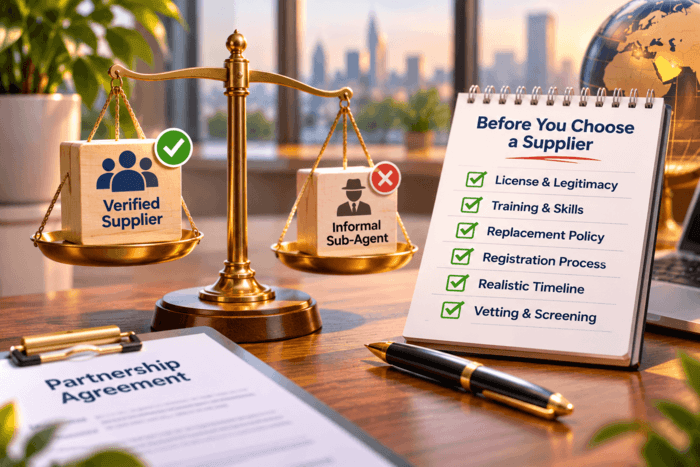
After the conversation, do not judge the supplier by how confidently each answer was delivered. Review what the receiving agency can actually verify. Evidence must match the role and destination of the actual order.
| Answer you receive | What it tells you | Your next move |
|---|---|---|
| ✅ Specific and supported | The claim has identifiable evidence and a responsible contact. | Verify the evidence and record the agreed next step. |
| 🟡 Detailed but incomplete | The supplier understands the issue, but a material detail is missing. | Ask one precise follow-up and set a response point. |
| ⚠️ Vague or inconsistent | The answer cannot yet support a reliable decision. | Pause the relevant commitment until the issue is clarified. |
Three Short Answer Tests
Case A — Licence: “Our licence is valid.” Ask for the registered entity, issuing authority, and verification route. Confidence is not evidence.
Case B — Training: “All candidates are experienced.” Ask how the relevant practical skills were assessed. Prior experience and observed competence are not the same thing.
Case C — Timing: “We can deliver very fast.” Ask which steps depend on approvals or receiving-side actions. A date without assumptions is difficult to manage.
📌 The decision rule: Accept explanations you can check. Clarify incomplete answers. Do not make an unsupported promise to your own client on the strength of a supplier's reassurance.
❓ Frequently Asked Questions
What Makes a Wholesale Manpower Supplier's Answer Verifiable?
A verifiable answer identifies a specific claim, supporting evidence, and a practical way to check it. It should also clarify who is responsible for the next action.
Is a Licence Number Enough to Assess a Supplier?
No. Confirm the legal entity, licensing authority, applicable scope, and current status. The agreement should identify the party that will actually provide the service.
How Can an Agency Challenge Vague Training Claims?
Ask for the role-specific curriculum, practical assessment method, and meaning of a passing result. Request clarification if the supplier offers only broad assurances.
Should Replacement Terms Be Agreed Before the First Order?
Yes. Review the written conditions, reporting procedure, responsibilities, exclusions, and possible costs before relying on any replacement promise.
What if a Supplier Avoids a Direct Question?
Ask once more in writing and specify the missing information. If the answer remains unclear on a material issue, delay that commitment until your agency can assess the risk.
🤝 Work With a Supplier That Welcomes Questions
A strong agency partnership begins with clear questions and answers that can be checked. Before sending your next demand letter, contact our partner team to discuss the evidence and information your agency needs.
We welcome careful questions about sourcing, preparation, and responsibilities at My Agency.